
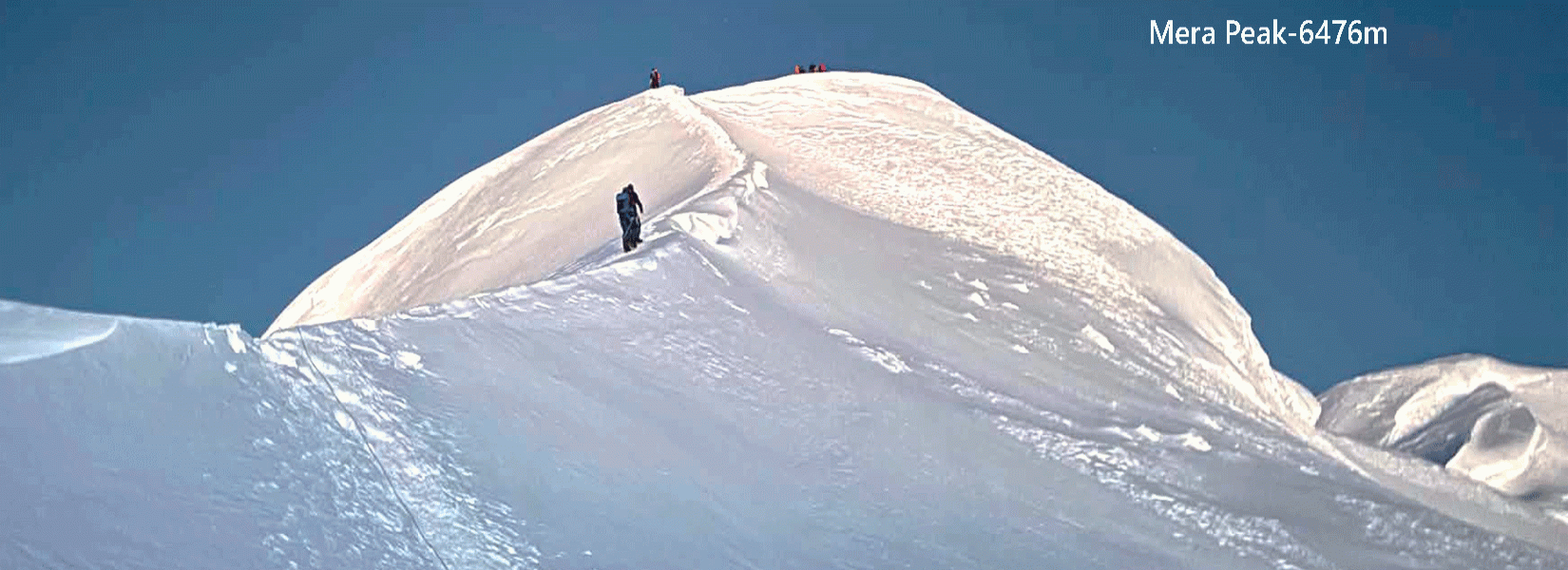
Mera Peak is the highest permitted trekking peak in Nepal, standing at an elevation of 6,476 meters (21,247 feet) above sea level.
Geography and Location
Location: Situated in the Hinku Valley of the Makalu-Barun National Park in the Solukhumbu/Mahalangur section of the Himalayas, just south of the Everest region.
Summits: It features three main summits: Mera North (6,476 m), Mera Central (6,461 m), and Mera South (6,065 m). Mera Central and Mera North are the most frequently targeted by climbers.
Scenery and Views
Panoramic Vistas: The summit offers unobstructed 360-degree views of five of the world's six highest 8,000-meter mountains: Mount Everest (8,848 m), Lhotse (8,516 m), Makalu (8,463 m), Cho Oyu (8,201 m), and Kanchenjunga (8,586 m).
Wilderness Approach: The trek winds through remote pine and rhododendron forests in the quiet Hinku Valley, offering a much more peaceful and pristine wilderness experience than the crowded Everest Base Camp route.
Climbing and Difficulty
Non-Technical Nature: Classified as a trekking peak, it does not require advanced rock or vertical ice-climbing skills. The ascent primarily involves walking on long, gradual snow slopes and low-angle glaciers (rarely exceeding 30 to 40 degrees).
The Challenge: The real difficulty lies in high-altitude endurance, thin air, and cold temperatures rather than technical ropes. The final few meters to Mera Central may require a short fixed-rope ascent on a steeper snow dome.
Best Seasons: Spring (April–May) and Autumn (October–November) offer the most stable weather and clear mountain views.
If you are planning an adventure, let us know for details information
Itinerary
Day 1: Arrival in Kathmandu (1,400m)
Land at Tribhuvan International Airport. Spend the day resting at your hotel, checking equipment, and meeting your climbing guide for a briefing.
Day 2: Kathmandu to Lukla (2,840m) & Trek to Chutanga (3,050m)
Flight: 35 mins | Trek: 3–4 hours
Catch an early morning flight to Lukla. After meeting your porters, start an immediate, steady uphill hike through lush pine and rhododendron forests to the small settlement of Chutanga.
Day 3: Chutanga to Thuli Kharka (4,300m) via Zatrwa La Pass (4,610m)
Trek: 6–7 hours
A demanding day. You will cross the steep Zatrwa La Pass. Reaching over 4,600m early in the trek is excellent for altitude acclimatization before descending down into Thuli Kharka for the night.
Day 4: Thuli Kharka to Kothe (3,691m)
Trek: 5–6 hours
Enjoy scenic descents through the rocky ridges and dense forests of the lower Hinku Valley. You drop elevation today, allowing your body to recover from the previous day's high pass climb.
Day 5: Kothe to Thaknak (4,350m)
Trek: 4–5 hours
The trail hugs the lateral moraine of the Hinku Dig Glacier. The vegetation begins to thin out into alpine meadows as giant peaks like Thamserku and Kusum Kanguru come into clear view.
Phase 2: Staging at Base Camp
Day 6: Thaknak to Khare / Mera Base Camp (5,045m)
Trek: 3–4 hours
A steady climb past the Dig Glacier to the spectacular high-altitude settlement of Khare, which serves as the base camp hub for Mera Peak.
Day 7: Acclimatization & Pre-Climb Training in Khare (5,045m)
Rest & Practice Day
Do not skip this day! Use the morning to practice using mountaineering gear—including crampons, harnesses, ascenders (jumar), and ice axes. Your guides will set up fixed ropes on small ice slopes nearby to ensure everyone is ready.
Day 8: Khare to Mera High Camp (5,780m)
Trek/Climb: 5–6 hours
Advance up the steep, rocky boulder fields to the edge of the glacier. Strap on your crampons and rope up for a gradual snow climb onto the pass and up to High Camp. Tents are pitched on a rocky shelf with staggering sunset views of Everest, Lhotse, and Makalu.
Phase 3: The Summit & Return Journey
Day 9: Summit Day: High Camp to Mera Peak Summit (6,476m) & back to Khare
Climb: 10–12 hours
An alpine start around 1:30 AM. You will make a slow, cold headlamp march up the non-technical glacier slopes. The final 30 meters features a steep snow dome that requires pulling yourself up a fixed rope. Stand at the highest trekking point in Nepal to watch the sunrise across five 8,000m giants before making a long descent back to Khare.
Day 10: Contingency / Reserve Day
Built-in Safety Cushion
An essential buffer day in case bad weather, heavy snow, or high winds prevent a summit attempt on Day 9. If you successfully summit on Day 9, this becomes a welcome rest day.
Day 11: Khare to Kothe (3,691m)
Trek: 5–6 hours
Descend back down the Hinku Valley. With the thick air returning, your energy levels will rebound dramatically.
Day 12: Kothe to Thuli Kharka (4,300m)
Trek: 6–7 hours
A steady uphill trek climbing out of the valley floor back to the high pastures of Thuli Kharka.
Day 13: Thuli Kharka to Lukla (2,840m) via Zatrwa La Pass
Trek: 6–7 hours
One last push back over the Zatrwa La Pass followed by a steep knee-burning descent into Lukla. Celebrate the successful expedition with your crew in town.
Day 14: Lukla to Kathmandu
Flight: 35 mins
Board the early morning mountain flight back to Kathmandu. Enjoy a hot shower and spend the evening shopping for souvenirs or relaxing in Thamel.
Day 15: Final Departure
Transfer to the international airport for your flight to home.


